

***
Food painting artwork
30 x 30cm acrylic and pen on canvas. As this recipe is all about the flavour of peanuts, this painting depicts the mythical peanut tree. Now as you might know, peanuts grow underground on the roots of a small bush. A bit like potatoes grow on the roots of the potato plant. That is why peanuts are also known as groundnuts, and also explains why they are actually a legume, not a nut.However, so many people think that peanuts grow on a tree that I decided to run with this as an artistic idea. The stylistic inspiration today is from the artist Jo Lynch who has a wonderfully fun and cheerful style that celebrates colour and the use of white negative space. I thought these two pictorial ideas could be ideal to explore for a mythical tree.
By the way, all the food painting artwork is available to own in the Official Art Store.
***
The meatless meals recipe
Many years ago now I gave this dish to a Scottish friend to make and test. He made it for himself and his housemates. It was reported back to me that his French housemate reckoned that this is the 'golo golo' mother of all sauces for stir fries. Apparently 'golo golo' is quite a compliment. My friend thought it was excellent too and very easy to make. So all of you peeps out there doing the Meatless Monday, this one's a good one for you.
2 tablespoons oil
6 cloves garlic
1 medium onion
1 tablespoon fresh grated ginger
1 small red chilli
2 tablespoons soy sauce
1 large tomato, diced
juice of 1/2 a lemon
2 cups coconut/soy milk/cow milk
2 cups peanut butter
handful peanuts
up to 1 cup of other chopped veges (carrot, mushrooms, beans)
Saute the garlic and onion in oil.
When soft add the ginger too. Keep sautéing.
Then add the chilli and then tomato (and other veges). Mix well. Cook until tomato collapses or until veges are basically done.
Stir in the soy sauce and the milk.
Then mix in the peanut butter.
When thoroughly mixed (it gets easier as it warms up), stir in the lemon juice. Add extra milk if it is all too thick.
Throw in a handful of peanuts and make sure everything is heated through.
Serve over rice.
Makes 5 bowls.
+++
More vegetarian cookbook goodies
Need help with conversions? Download this handy dandy pdf of cooking conversion charts for every cooking measuring system I could find. It should make your life easier.
Want to check out more vegetarian dinner recipes? They're all in the Table of Contents.
+++

***
Food painting artwork
25 x 30cm 190?gsm watercolour paper collage. Inspired by the texture of the pudding itself, we have triangles of bread and pieces of dried fruit, all made from paper and overlayed with a semi transparent sheet of paper hand lettered in coloured pencil with the actual recipe in a bold and magazine-layout influenced style.This piece is one of the original artworks from the first incarnation of the recipe book from around 10 years ago. The original concept was the same as the current one, with one important difference. Originally the entire book was going to be hand lettered and the artwork for each recipe was going to include the text as part of the design as you can see here. Clearly I didn't realise what a tremendous amount of painstaking work that was going to be. The project was abandoned. It's only now with a gentle shove from hubby and the more sensible separation of text and images that the cookbook is back and humming along.
By the way, all the food painting artwork is available to own in the Official Art Store.
***
The meatless meals recipe
This is our family bread and butter pudding. It's a traditional English recipe that I remember both my mother and grandmother making. Most memorable comment from a recipe tester guinea pig went something like, 'Fabbo. Cannot be beaten. Not even with a stick.'
6-8 slices (stale) bread
1 egg
1 1/2 cups dried fruit (and nuts and seeds - currants, raisins, sultanas, sunflower seeds, almonds)
1 teaspoon mixed spice (ground ginger, cinnamon, cardamom, cloves, nutmeg)
1/4 teaspoon ground cinnamon
1/4 teaspoon nutmeg
1 teaspoon baking powder ( this can be left out if you don't mind the pudding being a bit flatter than it would otherwise)
2 tablespoons (brown) sugar
1 tablespoon butter
4-5 cups milk
Heat oven to 350-400 F
Grease a basin to cook the pudding in (approx 20x20x5cm)
Break the egg into a flat bottomed container/bowl and beat with 1-2 cups milk (the more bread slices used the more milk you'll need here). Soak half the bread slices in this, squeezing the liquid in. Cover the bottom of the basin with these slices.
Top with the fruit/nuts/seeds. Sprinkle the spices and baking powder on evenly all over.
Soak and squeeze the remaining bread and use to cover the fruit. Tip any excess egg & milk mix in too. Top evenly with butter and sugar. Fill the basin to the top of the bread with milk.
Bake in the oven for 30-40 minutes until the top has browned and no running liquid is left.
Serves 4
+++
More vegetarian cookbook goodies
Need help with conversions? Download this handy dandy pdf of cooking conversion charts for every cooking measuring system I could find. It should make your life easier.
Want to check out more vegetarian dinner recipes? They're all in the Table of Contents.
+++
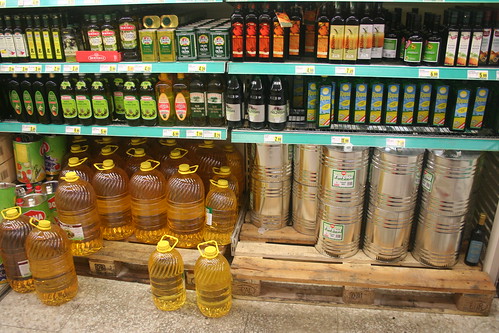 |
| Photo by dugspr — Home for Good |
It has been a boon of a discovery to me to stumble across a cheap, simple and non toxic way of cleaning up my brushes and palette after a session of oil painting. I swear, I wasn't even looking, and when I did come across this, I could not believe just how straightforward this is. It's so simple you may laugh in amazement and wonder why, just as I did, we are all taught to use turps, mineral spirits or OMS (odourless mineral spirits) to remove residual oil paint, when in fact, it's plain daft to be using these substances.
Let me explain.
The aim is to remove the oil paint from brushes and the palette. Using OMS and its cousins, paint is stripped away. As far as cleaning goes, it does work. But there are numerous problems with these substances. Stripping the paint also dries out and can eventually crack your palette. It also 'eats' the synthetic brush bristles or dries out the natural bristles making then brittle and less flexible. Either way, over time it destroys your brushes. Then there is the problem of OMS being a carcinogen that enters your body through inhalation or when you get it all over your skin. And it's a nonrenewable petroleum product. And it's an environmental hazard. Suffice to say, it's pretty bad stuff.
The other way to remove the oil paint from brushes and the palette is not to strip it off, but to dilute it and wash it away. So what other substances dilute oil paint? The answer is other oils. Um, like supermarket variety vegetable cooking oil.
Yes, bog standard vegetable cooking oil. Unlike OMS and it's cousins, vegetable oil is kind to your palette, effectively moisturises or conditions your brushes, is not a carcinogen (actually not harmful at all, you eat it), is a renewable plant resource and not harmful to the environment. It's one huge win all round.
So how do you use vegetable oil to clean your brushes? Easy peasy. Like this:

- Wipe off as much excess paint onto a rag or paper towel as possible.
- Swirl the brushes in a jar filled with vegetable oil to remove as much paint as you can.
- Wipe the brushes cleanish on a rag or paper towel.
- Give the brushes a final swirling, one at a time, in a second jar only partly filled with vegetable oil. When this jar's oil has become too filthy I decant this oil into another big jar. Then I put in another small amount - about an inch - of fresh oil into the second jar for the final swirling of the next few brushes.
- Then I wash the brushes in soap or dishwashing liquid and warm water, and carefully dry and shape them. (update - I have also discovered Disolv non toxic oil clean up for professional artists for this step and it is truly a wonder product made from waxes and detergents. It's an Australian made product too!)
Now they are as clean as they would be using OMS, as well as lovely and soft. My hands don't stink or have skin flaking off them and my head doesn't pound from the fumes that hang about for hours even with all the windows open. Win win win.
And what happens with the used oil? It gets tipped into a big jar and left alone to let the paint settle to the bottom. Then the usable oil is tipped out and reused, and the sludge at the bottom is disposed of.
Oh by the way, another little tip. When soaping up the brushes, it's wise to not use your palm to work the soap into the brush. If you do, trace amounts of pigment enter your body via the skin and over time these build up and some of them are quite nasty. I always work the soap into the brush against the bottom of the sink or in another jar or I wear a glove. It's also why I use (environmentally friendly) dishwashing liquid as it gets into the bristles and removes the oil a lot more easily than hard soap.
More art technique articles
 This article is one in an ongoing series of technical articles for artists, all archived together and accessible from here. The topics range from details on materials, to the business of art, to specific art techniques. Please make use of this resource.
And remember to check out my artworks on Flickr, and have an insider peek at my life as an artist on Facebook.

***
Food painting artwork
30 x 30cm acrylic and pen on canvas. Inspired by illustrations of the children's book variety. A giant apple is the sole fruit of this apple tree. James and the Giant Peach?
By the way, all the food painting artwork is available to own in the Official Art Store.
***
The meatless meals recipe
More appley goodness. This is unbelievably easy to do, especially if you are already using the oven to cook the main meal. And unlike most warming winter desserts which are high on fat and starch, it's pretty healthy being pretty much all fruit.
4 (cooking) apples1 citrus fruit
1/2 cup dried fruit (sultanas/raisins/currants)
4 teaspoons honey
4 dobs butter (1 teaspoons total)
approx 1 cup water
Juice the citrus and soak the dried fruit in this, squeezing the juice through.
Grease a baking tray with sides or use a baking dish.
Core apples. Score an equator around each one, just to break the skin so it doesn't burst (the skin contracts on cooking). Place the apples on the tray.
Half stuff each apple firmly with the soaked fruit. Put 1 teaspoon of honey in each and then complete stuffing them. Top each with a dob of butter.
Tip any spare citrus juice into the tray and top up with water up to (max) 1/2 cm. This creates a nice juice to serve with and prevents the apples from drying out.
Put in a 180 C/375F oven for 30 mins or until apples have started to brown.
Serves 4 with custard.
+++
More vegetarian cookbook goodies
Need help with conversions? Download this handy dandy pdf of cooking conversion charts for every cooking measuring system I could find. It should make your life easier.
Want to check out more vegetarian dinner recipes? They're all in the Table of Contents.
+++


 Posts
Posts

